Building Smarter:

How to Keep Your Commercial Project on Time and on Budget in Any Market

Because strong planning and the right team matter more than market conditions.

Every market has its challenges, prices rise, materials fluctuate, and timelines tighten. But successful projects don’t depend on perfect conditions; they depend on smart planning.

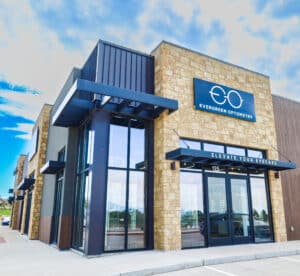
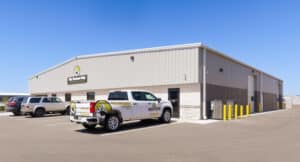
At Hammers Construction, we’ve spent over 30 years helping Colorado businesses navigate every type of market. Whether you’re building a medical office, retail space, or a commercial development, the right process can keep your project steady, even when the market isn’t.

Overview

Before you dive into design and budgeting, it helps to know what really moves the needle.

In this guide we will answer questions like :

  • How does design-build delivery reduce risk and control costs?
  • What are the most effective ways to plan ahead for unpredictable markets?
  • How can value engineering add efficiency without sacrificing quality?
  • Why do local relationships matter so much in Colorado’s construction scene?
  • What role does communication play in keeping projects on track?

If you’re planning a commercial project in Colorado, these insights will help you make smart, informed decisions that protect both your budget and your peace of mind.
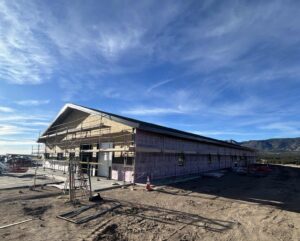
Start with the Right Project Delivery Method

Traditional construction often means juggling multiple contracts, competing priorities, and unclear communication. Design-build simplifies it.

With design-build, one team handles design, engineering, and construction under a single contract. That means faster decisions, stronger collaboration, and fewer surprises. It’s a system proven to save time and reduce costs while keeping accountability in one place, right where it should be.

Plan Early, Build Efficiently 

The best way to protect your budget is to plan before you pour.

Our pre-construction team focuses on early-stage feasibility, cost forecasting, and long-lead procurement so clients avoid last-minute shocks that derail budgets. By identifying key materials and trades early, we help lock in pricing and secure schedules, especially important in Colorado’s busy construction climate.
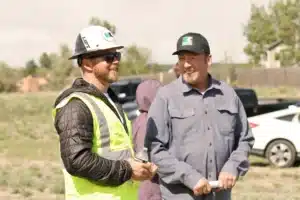
Value Engineering Without Cutting Corners

“Value engineering” isn’t about cheap shortcuts, it’s about smart choices.

We look at how every element of a project performs over time. That can mean switching to locally sourced materials, optimizing building systems for long-term energy savings, or using prefabrication to speed up delivery without sacrificing quality.

The goal is always the same: lower lifecycle costs and a stronger finished product.

Build Local, Build Smart

Colorado’s commercial construction scene moves fast, especially along the Front Range. Local relationships matter.

Our vendor and subcontractor partnerships help shorten lead times, manage volatility, and ensure projects meet regional standards from start to finish.

Plus, working with a contractor who understands local permitting, zoning, and environmental conditions can save you weeks in approval time.
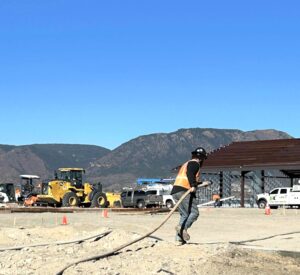
Confidence Through Communication

Transparency is one of the biggest predictors of project success.

Our design-build model keeps owners involved at every step, with open-book budgeting, schedule visibility, and real-time updates. When everyone’s on the same page, projects stay on time, on budget, and on goal.

Conclusion

The truth is, markets will always shift, but your plan doesn’t have to. At Hammers Construction, we combine local experience, integrated design-build delivery, and proven project control to turn uncertainty into opportunity.

Ready to start your next commercial project? Let’s plan it together.

Frequently Asked Questions

What makes design-build more reliable in unpredictable markets?

Design-build creates one unified team responsible for both design and construction. That reduces delays, miscommunication, and change orders, all of which protect your budget when market conditions shift.

When should I start planning my commercial project?

Ideally six to twelve months before you want to break ground. Early planning allows for accurate pricing, permitting prep, and material forecasting, especially important in Colorado’s fast-paced market.

What is value engineering and why is it important?

Value engineering looks for cost savings without cutting quality. It’s about choosing smarter materials, improving efficiency, and optimizing long-term performance, not simply reducing the price tag.

How does Hammers Construction help control costs?

We use transparent, open-book budgeting and early-stage procurement strategies to lock in pricing where possible. Our design-build process also minimizes change orders and delays, which keeps overall costs predictable.

What areas of Colorado does Hammers Construction serve?

We build across the Front Range, including El Paso, Elbert, Teller, Douglas, and Pueblo Counties, with deep local knowledge of regional permitting, zoning, and environmental requirements.

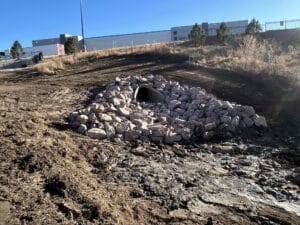
Stormwater Management in Colorado: What Property Owners Need to Know

Stormwater management is one of those things that rarely gets attention until it becomes a problem. Then it becomes everyone’s problem.

In Colorado, municipalities and state agencies are increasingly strict about stormwater compliance, especially along the Front Range. Whether you are developing a new site, expanding an existing facility, or maintaining commercial property, having a clear and compliant stormwater management plan is no longer optional.

At Hammers Construction, we help property owners and developers in Colorado Springs and Denver stay ahead of evolving stormwater regulations while protecting their investment, their schedule, and Colorado’s water supply.

What Is Stormwater Management and Why Does It Matter?

Stormwater is rain or snowmelt that flows across paved surfaces, rooftops, and disturbed ground. As it moves, it picks up sediment, debris, oil, chemicals, and other pollutants. Without proper controls, that runoff can enter local streams, lakes, and groundwater.

From a regulatory standpoint, unmanaged stormwater creates liability. From a practical standpoint, it creates erosion, flooding, and long-term maintenance issues that are expensive to fix later.

A well-designed stormwater management system helps you:

  • Remain compliant with local, state, and federal regulations
  • Reduce the risk of fines, violations, and lawsuits
  • Protect Colorado’s water resources
  • Improve the appearance and function of your site
  • Avoid costly rework or emergency fixes after inspections

Stormwater Compliance Is Changing in Colorado

Many municipalities across Colorado Springs, Denver, and surrounding areas are tightening enforcement around stormwater runoff, inspections, and maintenance. Requirements don’t stop once construction ends either. Ongoing inspections, reporting, and maintenance are often required to remain compliant long-term.

That’s why stormwater should not be treated as a checkbox at the end of a project. It works best when it’s addressed early and managed consistently.

Hammers’ Approach to Stormwater Management

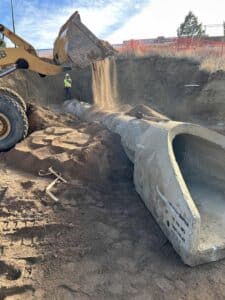
Hammers Construction provides full-service stormwater management solutions, from initial assessment through long-term maintenance. Our team works with owners, developers, and municipalities to ensure systems are designed correctly, built efficiently, and maintained properly.

We structure our stormwater services around four key phases.

Establish: Design, Build, and Permit

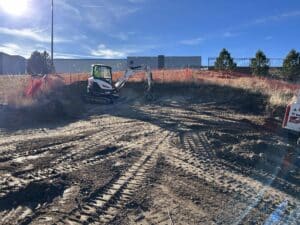
We design and build stormwater systems from the ground up, including permitting and coordination with local jurisdictions. Our experience with municipal requirements helps streamline approvals and avoid delays.

Common systems we establish include:

  • Forebays
  • Trickle channels
  • Micro pools
  • Extended detention basins
  • Upper-stage stormwater features

Enhance: Repairs and Compliance Corrections

If an existing system is not functioning properly or has failed inspection, we step in to correct deficiencies and bring the site back into compliance.

This often includes:

  • Repairing trickle channels, pads, and ponds
  • Addressing retaining walls and structural elements
  • Modifying inlets and outlets to improve performance

Ensure: Ongoing Maintenance

Stormwater systems require regular maintenance to remain effective and compliant. We handle the ongoing work so property owners don’t have to.

Maintenance services include:

  • Landscaping and vegetation control
  • Erosion and sediment control
  • Algae control
  • Mowing and trash removal

Evaluate: Monitoring and Reporting

Compliance does not end with installation. We provide hands-on monitoring, inspections, and periodic reporting to keep your property aligned with permit requirements and local agreements.

Our Stormwater Process

Every property and site is different, which is why we take a straightforward, step-by-step approach.

  • Step 1: Assess Our team evaluates your existing stormwater system or proposed site conditions and identifies areas that need improvement or adjustment.
  • Step 2: Plan We develop a cost-effective stormwater management plan designed to prevent runoff from entering local water supplies while meeting all regulatory requirements.
  • Step 3: Execute Once the plan is approved, we build and implement the necessary stormwater structures and controls to keep your project compliant and functional.

Experience You Can Rely On

Hammers Construction has decades of experience delivering commercial and municipal projects throughout Colorado. We understand the additional requirements that come with public-sector work, complex permitting environments, and inspection-driven schedules.

Our clients rely on us not just to build, but to navigate regulations, coordinate with agencies, and solve problems before they become delays.


Protect Your Project and Your Business

Stormwater management is about more than compliance. It is about protecting your project, your reputation, and your long-term investment. Whether you need to update an existing system, address inspection concerns, or design stormwater controls for a new development, Hammers Construction is ready to help.

Contact us today to request a quote or to learn more about stormwater management solutions in Colorado Springs and Denver.

One team. One contract. One shared vision for your success.

If you’ve ever started a commercial project and felt overwhelmed by all the moving parts, multiple contracts, delayed communication, and surprise costs, you’ve experienced the old-school way of building. Traditional methods separate design and construction, which can create confusion, finger-pointing, and wasted time.

At Hammers Construction, we take a different approach. Our design-build process brings every part of your project together under one roof, from concept and design to construction and completion. The result is a faster, smoother experience with better communication and greater control over cost and schedule.

Overview

In this article, we’ll cover:

  • The difference between design-build and design-bid-build
  • How the Hammers Construction design-build process works from start to finish
  • Why design-building leads to better communication, faster timelines, and stronger outcomes
  • What common myths still exist about the design-build model
  • How our local ability gives Colorado businesses a clear advantage

What is Design-Build (and Why It’s Different)

Design-build is a project delivery method where one team handles both the design and construction phases under a single contract. That means you have one point of contact, one source of accountability, and one cohesive team working toward your vision.

Traditional design-bid-build separates those responsibilities. You hire an architect to design your project, then bid it out to contractors, hoping the numbers align. It’s a fragmented system that often leads to cost overruns, miscommunication, and delays.

Design-build eliminates that gap. Collaboration starts early and continues through every stage of the project. Architects, engineers, and builders work side by side to align design intent, budget, and constructability from day one.

The Hammers Construction Design-Build Process

For over 30 years, we’ve refined a design-build system that keeps projects efficient, transparent, and stress-free.

Here’s how our process works:

  • Step 1: Discovery and Feasibility We start by understanding your goals, budget, and site conditions. Our team studies your vision, analyzes zoning and permitting needs, and develops an initial cost framework.
  • Step 2: Design and Pre-Construction Our architects and estimators collaborate from the start. This early alignment prevents scope creep and surprises later. We also identify long-lead materials and lock in pricing where possible.
  • Step 3: Permitting and Procurement With deep local experience in Colorado’s regulatory environment, we manage submittals, utility coordination, and procurement efficiently. This step helps prevent delays and keeps schedules predictable.
  • Step 4: Construction and Communication Once construction begins, the same team that designed your project stays by your side. You get regular progress updates, schedule transparency, and real-time cost tracking. No surprises, no disconnect.
  • Step 5: Project Closeout and Beyond We finish strong. From final inspections and warranty coordination to maintenance guidance, we make sure your facility performs long after we hand you the keys.

Why Design-Build Works Better for Colorado Businesses

Colorado’s construction market moves quickly. Between variable weather, permitting timelines, and material costs, every project benefits from speed and collaboration.

Because design and construction overlap in the design-build model, schedules move faster, budgets stay tighter, and communication stays clear. Our integrated team also brings local knowledge of building codes, zoning, and regional vendors, key advantages for any project along the Front Range.

Common Myths About Design-Build

Let’s clear up a few common misconceptions we hear:

  • Myth 1: Design-build is only for large projects. Not true. It’s scalable and works for everything from small tenant improvements to complex ground-up developments.
  • Myth 2: Owners lose control over design. Actually, you gain more control. Because the entire team collaborates early, your ideas are refined with real-time cost and constructability feedback.
  • Myth 3: It’s more expensive. Design-build reduces costly change orders and schedule delays, often making it the most cost-effective approach in the long run. On average, clients save 30% by using the design build method.
  • Myth 4: It limits creativity. Our design-build team includes designers, engineers, and trade experts who all collaborate to bring your vision to life, efficiently and creatively.

Conclusion

At Hammers Construction, design-build isn’t just a delivery method, it’s our philosophy. We believe that collaboration, communication, and accountability lead to better projects and happier clients.

If you’re planning a commercial project in Colorado, our design-build team is ready to help you bring your vision to life.


Frequently Asked Questions

What is the biggest benefit of design-build?

You get a single point of responsibility, which eliminates miscommunication and helps ensure your project is delivered on time and within budget.

Can I still choose design elements I care about?

Absolutely. Design-build enhances your involvement. You stay part of every design milestone with clear visuals, pricing, and options before decisions are made.

Is design-build faster than traditional construction?

Yes. Because design and construction phases overlap, design-build projects typically finish 30% faster on average.

Does design-build mean lower quality?

Not at all. In fact, collaboration across disciplines often leads to higher-quality outcomes because everyone is focused on performance, not just design aesthetics or cost.

What types of projects work best for design-build?

Commercial offices, retail centers, development projects, medical and dental clinics, and tenant improvements all benefit from this streamlined process.